Damschen Lab Ph.D. Position in Plant Community Assembly

The Damschen Plant Community Ecology Lab in the Department of Integrative Biology at the University of Wisconsin-Madison is accepting applications for 1 Ph.D. student that will start in Fall 2026.
Overall, our lab seeks to understand the impact of local and regional processes on plant community composition and diversity within the context of global change impacts and potential conservation and restoration solutions. Our research lies at the interaction of basic and applied community ecology, using long-term datasets, large-scale experiments, and functional traits to test basic theory with relevance to applied conservation management. While we work across ecosystem types, we focus on fire-maintained grasslands and savannas. More information about our research group can be found here: https://damschenlab.zoology.wisc.edu/
We are seeking one Ph.D. student for Fall 2026 to work within the Corridor Project, a long-term and large-scale habitat fragmentation experiment at the Savannah River Site (SRS) near Aiken, South Carolina that tests for the impacts of habitat connectivity on community assembly and diversity. The successful candidate will develop research questions that utilize this unique long-term landscape experiment to test for the impacts of landscape connectivity on plant community dynamics at the population and/or community levels. To help consider relevant questions, a list of publications from the Corridor Project is at: https://nickhaddadlab.com/publications/corridor-project-at-the-savannah-river-site/. Successful future research will require using ecological theory to develop and test hypotheses about how plant communities are affected by connectivity and patch shape. This project will require travel to the field sites in South Carolina for the summer field season and potentially other times, so successful applicants should be interested in and able to travel between their home institution (UW-Madison) and the field sites near Aiken, SC.
The graduate student will not only interact with members of the Damschen Lab, but will also interact closely with the US Forest Service-Savannah River, other graduate students, postdocs, field technicians, local natural resource managers, as well as the project’s principle investigators: Ellen Damschen (University of Wisconsin-Madison), Lars Brudvig (Michigan State University), Nick Haddad (Michigan State University), John Orrock (University of Wisconsin-Madison), Melissa Burt (Tusculum University), and Julian Resasco (University of Colorado-Boulder).
Successful applicants will have a range of prior experiences in both theoretical and applied, field-based ecology as well as the ability to collaborate with academics, land managers, and land owners. We seek applicants with significant previous leadership experiences, for example, leading field crews, helping to curate and manage large datasets, and seeing ecological projects through from design to publication. Qualified applicants should have a strong background in ecology and evolution, experience identifying and sampling plant communities, experience using statistical models to analyze data (ideally programming in R), and very strong writing and oral communication skills. In addition, because we train large numbers of undergraduates, successful applicants should have the experience and interest in serving as research mentors. The position will be funded by a combination of teaching and research assistantships. Because the Savannah River Site is a highly secure area run by the U.S. Department of Energy, non-United States citizens may have difficulty gaining clearance to work there.
Our lab welcomes all people and perspectives in our science, our lab culture, and in our broader communities. We are dedicated to continually working to build a lab culture that values unique perspectives, innovation, and collaboration.
Applications are due by December 1, 2025. Instructions on how to apply can be found at https://integrativebiology.wisc.edu/prospective-graduate-students/. Please indicate in your application that you are interested in applying to Ellen Damschen’s Lab and write about potential questions you could address within a Ph.D. program in our lab that address the themes above.


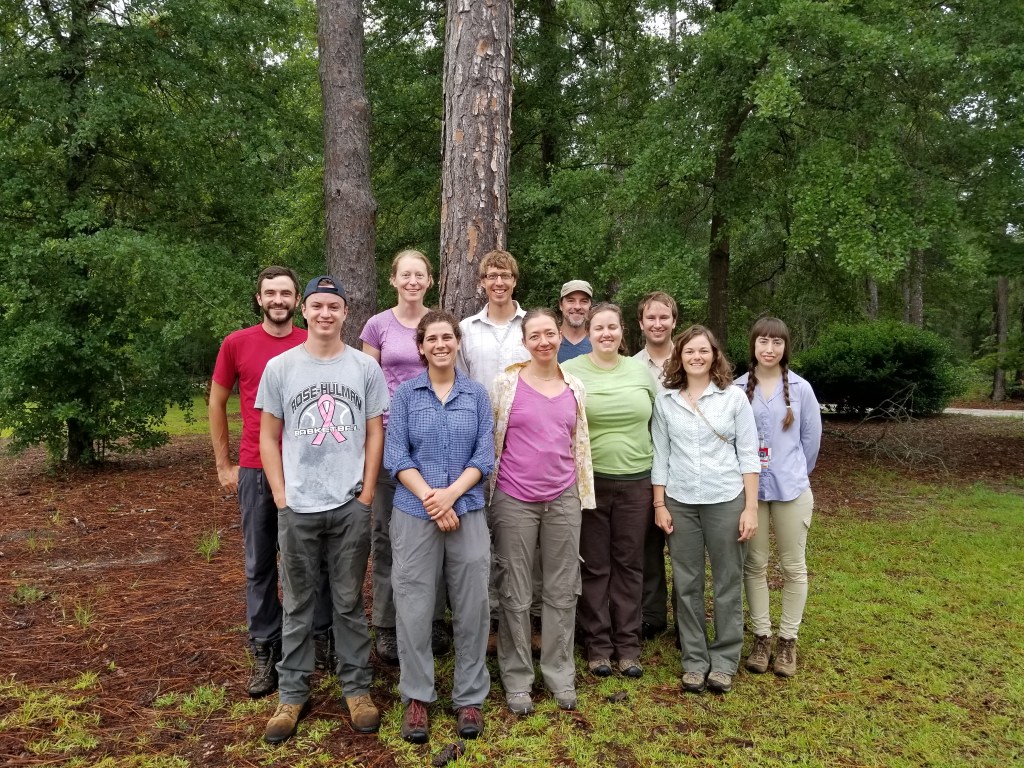


 Damschen Research Lab