Former Graduate Students
angelica bautista (MS 2025)
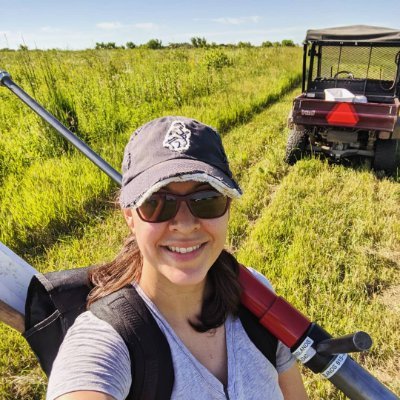
In my research, I ask how habitat degradation affects seed availability and whether seed limitation predicts long-term plant community dynamics in the longleaf pine savanna of the southeastern United States. While it is clear that seeds play a key role in promoting and maintaining plant diversity and that climate and land use alter the number and types of species that emerge, the mechanisms underpinning these patterns have not been tested, and the role of fire regimes and a changing climate are unclear. Isolating the direct and indirect effects of fire, land use, and climate change on seed survival is a key next step. My research on fire effects and post-fire community recovery will help inform fuels and prescribed fire management in a changing climate and across landscapes with varying land use histories.
Email: abautista3 [at] wisc.edu
Katherine T. Charton (PHD 2024) – POSTDOC, university of MINNESOTA

I am broadly interested in how climate, disturbance, and their interaction impact plant communities. During my time in the Damschen Lab, I worked on two long-term field experiments in southern Wisconsin tallgrass prairies, one focused on the interaction of management type and timing and winter snow cover and the other on the interaction of woody plant encroachment and management, environmental context, and summer drought. I collaborated with land managers at the UW-Arboretum, The Prairie Enthusiasts, the Southern Wisconsin Bird Alliance, and the Wisconsin State Natural Areas Program to better understand how management decision making can help us mitigate climate change and maintain grassland biodiversity and ecosystem services into the future.
jon henn (PHD 2020) – POSTDOC, university of colorado-boulder & university of california-riverside

I study how functional traits can help explain plant responses to factors like climate change, species invasions, and changing disturbance regimes. My research focuses on these issues to improve the restoration and management of ecosystems under rapidly changing conditions. In addition to doing research, I actively work on developing effective mentoring, teaching, and outreach skills because I believe that scientists need to be effective mentors, teachers, and communicators to help cultivate the next generation of scientists and engaged citizens.
JEANNINE RICHARDS (PHD 2020) – Assistant Professor, FLOrida Gulf Coast University

I am interested in the controls over tropical epiphyte diversity and how social and economic impacts alter their composition and abundance. I recently completed my Ph.D. in spring 2020 studying epiphyte diversity in Nicaragua. I am now a postdoc at the University of Wisconsin-Madison after receiving a National Science Foundation Postdoctoral Fellowship.
Quinn Sorenson (pHD 2019) – POSTDOC, University of California-Davis

I focus on plant community ecology in the context of agricultural land-use history and habitat fragmentation in the U.S. Southeast longleaf pine ecosystem. I am interested in understanding how the legacies of agriculture on soil and belowground processes affect plant communities and restoration success. Within the Corridor Project, a well-replicated landscape experiment testing the effects of corridors, I am interested in how landscape connectivity affect the development of plant communities over time. I have a strong background in land management and restoration ecology in coastal sage scrub and grasslands of southern California. I hope to use my research to test ecological theory as well as inform conservation planning and restoration efforts.
Amy Alstad (phd 2017) – Director of Land Management & Environmental Education, holy wisdom monastery

I am a former graduate student in the Damschen lab. My Ph.D. research where I investigated long-term changes in the plant communities in Wisconsin prairie remnants. I resampled prairie sites first studied by John Curtis in the 1950s, and compared the past and present plant communities to ask questions about the effects of landscape context, climate change, and plant functional traits. My aim with this research included both providing answers to open questions in ecological theory, as well as generating results with tangible conservation and restoration applications.
Jesse Miller (phd 2016) – Lead Botanist, Washington Natural Heritage Program

I am currently the Lead Botanist for the Washington Natural Heritage Program, where I provide scientific guidance for rare plant conservation efforts statewide. Previously, I worked as a lecturer at Stanford for four years, teaching inquiry-based ecology courses in collaboration with Tad Fukami. I spent two years as a postdoctoral researcher at the University of California-Davis, where I studied effects of fire severity and altered fire regimes on plant and lichen communities in Hugh Safford’s lab. I completed my Ph.D. in Ellen Damschen’s lab at the University of Wisconsin-Madison, where I studied the influence of habitat connectivity, fire history, and soil resource availability on plant community composition and vegetation structure in glades (shallow soil grasslands) in the Ozarks of Arkansas and Missouri. Before graduate school I worked for several years as a field botanist, surveying for rare plants on federal land and conducting ecological studies for academic research labs. My research today is grounded in the natural history knowledge and skills I began developing earlier in my career.
MELISSA SIMON (MS 2010)
Former Postdocs
LAURA LADWIG – Assistant Professor, University of Wisconsin-OshKosh

Ecological communities are in constant flux. Organisms thrive and decline. Species come and go. Whole systems can be altered by a change in one aspect of the community, and as communities change, so too do the services they provide. Understanding what causes ecological communities to change and evaluating the consequences of said change are the basis of my research. The majority of my research revolves around plants. How plants respond to the environment, react to changing conditions, and influence the surrounding community. Plants are critical components of many food webs and have a large influence on the environment, so understanding how plants change informs us about the whole system.
LARS BRUDVIG – PROFESSOR, MICHIGAN STATE UNIVERSITY
CATHY COLLINS – ASSOCIATE PROFESSOR, BARD COLLEGE
JEN CRUZ – ASSISTANT PROFESSOR, BOISE STATE UNIVERSITY
BRETT MATTINGLY – ASSOCIATe PROFESSOR, EASTERN CONNECTICUT STATE UNIVERSITY
JOE VELDMAN – ASSISTANT PROFESSOR, TEXAS A&M UNIVERSITY
Portraits courtesy of Liz Kozik.
 Damschen Research Lab