Let the field season begin! Fieldwork is a year-round undertaking in the Damschen lab’s long-term experiment in a restored tallgrass prairie at Mounds View Grassland in Iowa County, Wisconsin, where we shovel snow in the winter, prepare for prescribed burns in spring and fall, and collect prairie plant community data in the summer. The lab has maintained this experiment since 2016 to investigate the long-term, interacting effects of prescribed fire timing and winter snow depth on plant community composition. While the community composition of long-lived perennials is resilient to short-term changes, early spring is an especially vulnerable time for resprouting perennial plants and seeds breaking dormancy. Determining whether fire timing and snow depth alter emergence phenology, or when plants break the soil surface in spring, is a focal point of Michelle Homann’s research in collaboration with the Midwest Climate Adaptation Science Center (MW CASC).
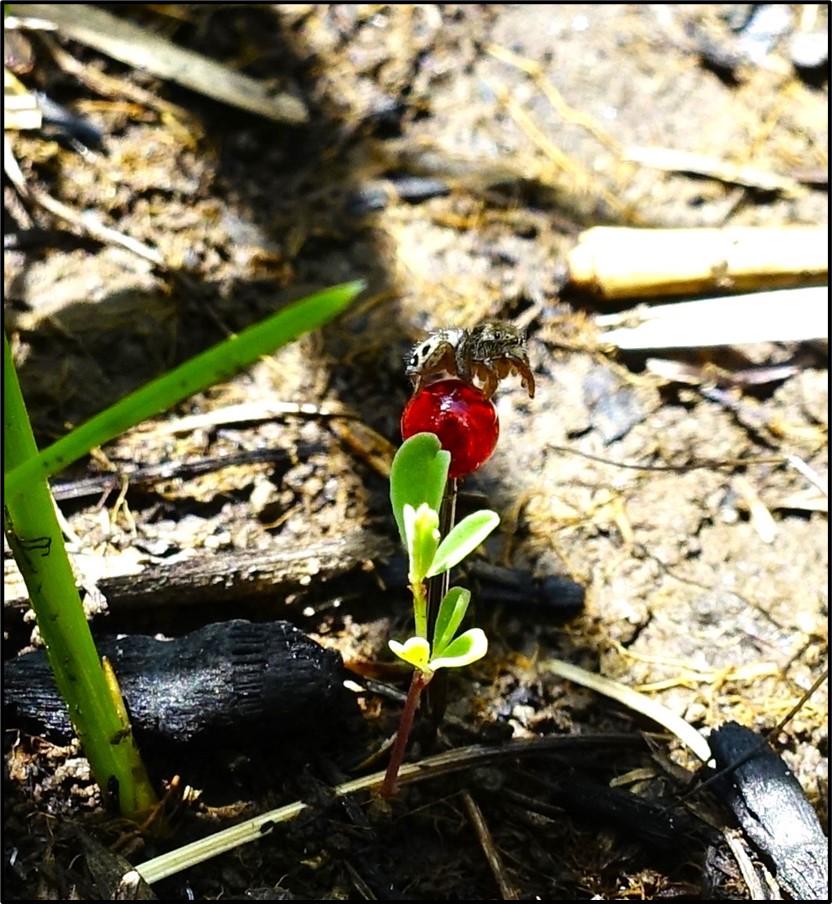
Soil temperature and moisture levels can cue plants to break dormancy, and we have found that litter removal during fall burns, in combination with reduced snow depth, leads to colder and more variable soil temperatures early in spring. This past winter, funding from the MW CASC supported the purchase of nine soil moisture dataloggers to allow comprehensive moisture data collection across our study plots that had previously gone unmeasured. Michelle will be extracting and analyzing those data later this summer – she expects that, like temperature, soil moisture will be affected by fire timing and snow depth and may explain some of the differences we see in emergence phenology, seed germination, and seedling establishment in restored prairies.
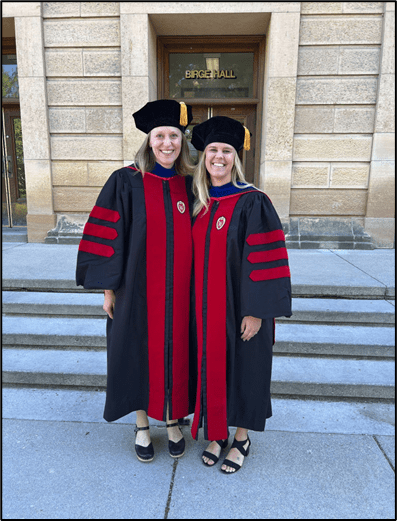
Major milestones from this spring. The Damschen lab is so excited to congratulate former graduate student Katherine Charton for successfully defending her PhD in May! In addition to her work at Mounds View Grassland, Katherine’s dissertation research centered around the effects of woody species management and drought on plant physiology and community composition in tallgrass prairies. Katherine is incredibly passionate about conducting research that is directly applicable to land managers, and this dedication shines in her work. While we will miss her dearly, the lab is excited to send Katherine off to the University of Minnesota in the fall, where she will continue working with the MW CASC as an Institute on the Environment Postdoctoral Fellow.
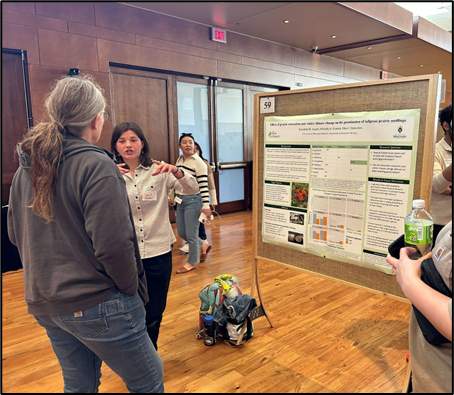
We would also like to congratulate Sam August for completing her senior thesis (a year early!) and presenting her research at the University of Wisconsin-Madison Undergraduate Research Symposium! Sam and her mentor, Michelle, have been studying how freeze-thaw cycles and soil moisture affect seed germination and viability in both the laboratory and the field at Mounds View Grassland. Sam joined the lab in 2021 and will be working with Michelle again this summer to continue collecting plant community data. We are excited for Sam to stay in the lab during her fourth year at the University of Wisconsin-Madison to continue doing research while she finishes her degree.
Former undergraduate students Rosalie Powell and Benji Jackson attended the Midwest-Great Lakes Society for Ecological Restoration Annual Meeting in May to present their research. Benji flew in from Georgia to present research focused on the effects of fire frequency on Desmodium canadense (showy tick-trefoil) biomass and root nodulation. Rosalie won a Student Oral Presentation Award for her talk on soil function in response to fire timing and snow depth, as well as woody management type and drought occurrence. Rosalie graduated with a BS this spring and is working with Katherine to publish this research. This is a major accomplishment, and we are so impressed with both Benji and Rosalie!
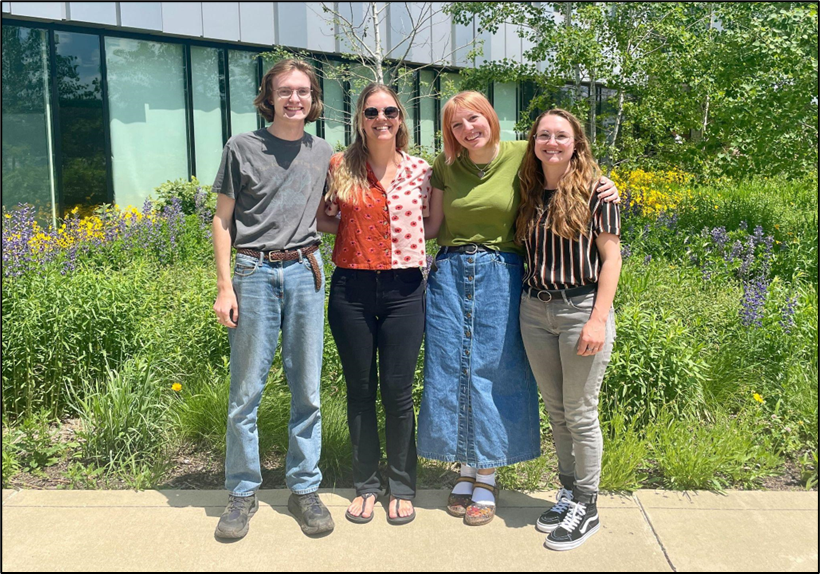
Looking forward to summer. Between Michelle collecting weekly seed germination and seedling establishment data and Katherine working toward publishing her research, both will be leading field trips out to our research sites at Mounds View Grassland. This July, Michelle and our management partners at The Prairie Enthusiasts Empire-Sauk Chapter will lead a field trip with Tribal REU students, and Katherine and Michelle will host a site visit with land managers and stakeholders. We are excited to share our findings and discuss pressing questions regarding tallgrass prairie management.
Members of the Damschen lab will also be sharing our research widely at many conferences this summer, including the Botanical Society of America, Ecological Society of America, and Midwest Climate Adaptation Science Center Annual Meetings.
Stay tuned for more results from this work! We will be sharing blog posts here (on our website) biannually throughout the next few years to keep you updated on our research progress, highlight new findings and stellar students, and provide access to communication materials on best management practices.
 Damschen Research Lab